


This was a lovely sunny weekend and spring is just across the corner in Britain and I with a friend decided to travel east and we stumbled upon the Spitfire museum and entered grabbed a fresh drink as we were tired rushing through and after we entered the garden of the museum and eventually walked around the building to walk inside.
The air carried that quiet warmth particular to early British spring. The sun had begun to soften the stubborn chill of winter and the sky hung wide and pale blue above the low brick buildings. Nothing felt rushed. Cars rolled past lazily along the road and somewhere beyond the hedges a dog barked with the mild impatience of a countryside afternoon.
From outside the building the museum seemed modest almost shy about what it held inside. A few banners hung on the walls. A poster showing wartime aircraft banking through clouds. A simple sign pointing visitors toward the entrance. If you did not know the story you might pass it without realising that within these walls lived one of the most enduring symbols of Britain’s survival.
Inside the building the air shifted. Museums have their own climate. A mixture of polished floor wax aged paper metal and quiet reverence. The first objects greeted us almost casually as if waiting patiently for attention. A wartime motorcycle stood beneath the broad wing of an aircraft. Olive drab paint dulled by time. Saddlebags hanging from the rear. A helmet resting on the seat as though the rider had simply stepped away for a moment.
Above it the unmistakable elliptical wing stretched out with the Royal Air Force roundel centred proudly in blue red and white. Even before reading the placards the silhouette told its story. The Spitfire.
We walked slowly deeper into the hall and the aircraft revealed itself piece by piece. The nose with its spinner painted bright red. The propeller blades angled like frozen motion. Riveted aluminium panels catching the overhead light in quiet reflections. One Spitfire stood partly opened exposing the intricate mechanical life beneath the cowling. Pipes cables cylinders and engineering that once turned aviation into survival.
The aircraft bore markings KH Z and the serial TB752. This was not a replica. This was a survivor.
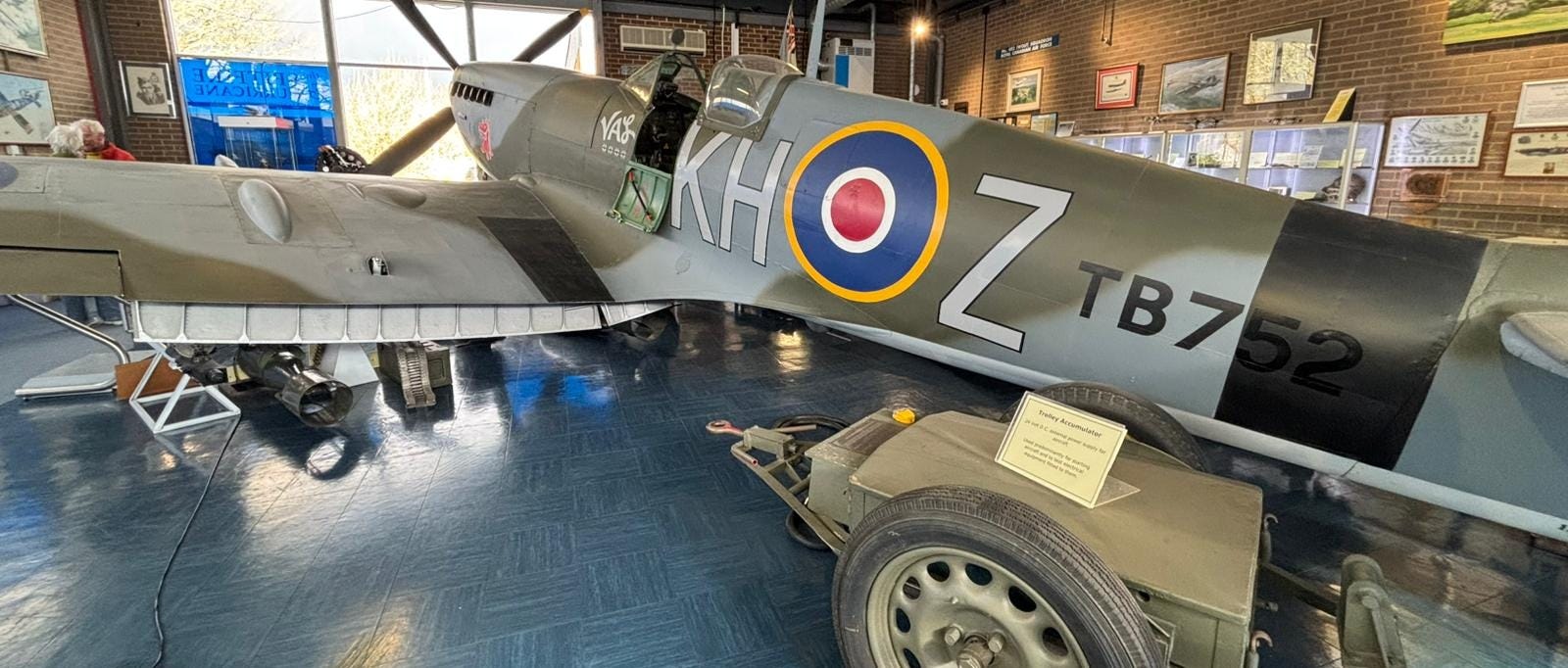
Under its wings museum staff had laid out the instruments of war. A 500 pound bomb fitted with its carrier and release mechanism. Heavy ammunition belts. A machine gun mounted on a stand. Even disarmed and silent they carried a weight of history that pressed quietly against the room.


Nearby a flight simulator had drawn the curiosity of visitors. Two men sat inside the cockpit replica staring at a curved bank of monitors showing countryside rushing beneath virtual wings. Their faces carried the half serious concentration of children allowed to play with the past. Outside the window the blue glass of the museum reflected the reversed words The Spitfire and Hurricane Museum.
In another glass cabinet rested the personal objects of pilots. A leather flying helmet with thick goggles. A breathing mask connected to ribbed rubber tubes. The apparatus looked primitive by modern standards yet it once allowed young men barely out of school to climb into freezing skies above Europe.
Next to it lay a small gas mask. The label explained it quietly.
Examples of a child’s and an adult’s gas mask from the Second World War.
The brown rubber face stared outward through round glass eyes. It was unsettling. War had not only prepared pilots and soldiers. It had prepared children.
Another display contained binoculars once used by naval crews scanning the cold grey sea for the approach of enemy ships. A German sailor’s cap band bearing the name Scharnhorst lay beside them. A reminder that the war did not belong to one nation alone but was fought by countless individuals on every side of a shattered continent.
Further along the room the exhibits grew more technical. Cameras once mounted inside aircraft wings to record combat encounters. Navigation instruments. Radio equipment. Small notebooks with flight logs and coordinates scribbled in careful wartime handwriting. These were the tools of pilots who lived minute by minute in a sky that could erupt into violence at any moment.
Then the aircraft itself returned into full view.
Standing beside a Spitfire is a strange experience. Photographs never convey its proportions properly. The fuselage is slender almost delicate. The wings curve gracefully outward like a bird at rest. Yet every inch of the design was engineered for speed manoeuvrability and survival.
The Spitfire was designed by R J Mitchell at Supermarine and first flew in 1936. By the summer of 1940 it had become the defining weapon of the Royal Air Force during the Battle of Britain. Historians have long emphasised the partnership between the Spitfire and the Hawker Hurricane. The Hurricanes bore the brunt of the bomber attacks while the faster Spitfires intercepted the German fighter escorts. Together they formed the shield over southern England. According to the RAF Museum and the Imperial War Museums more than 20000 Spitfires were built during the war making it one of the most produced and continuously developed fighters in aviation history.
Inside the museum the story unfolded not in grand speeches but through objects.
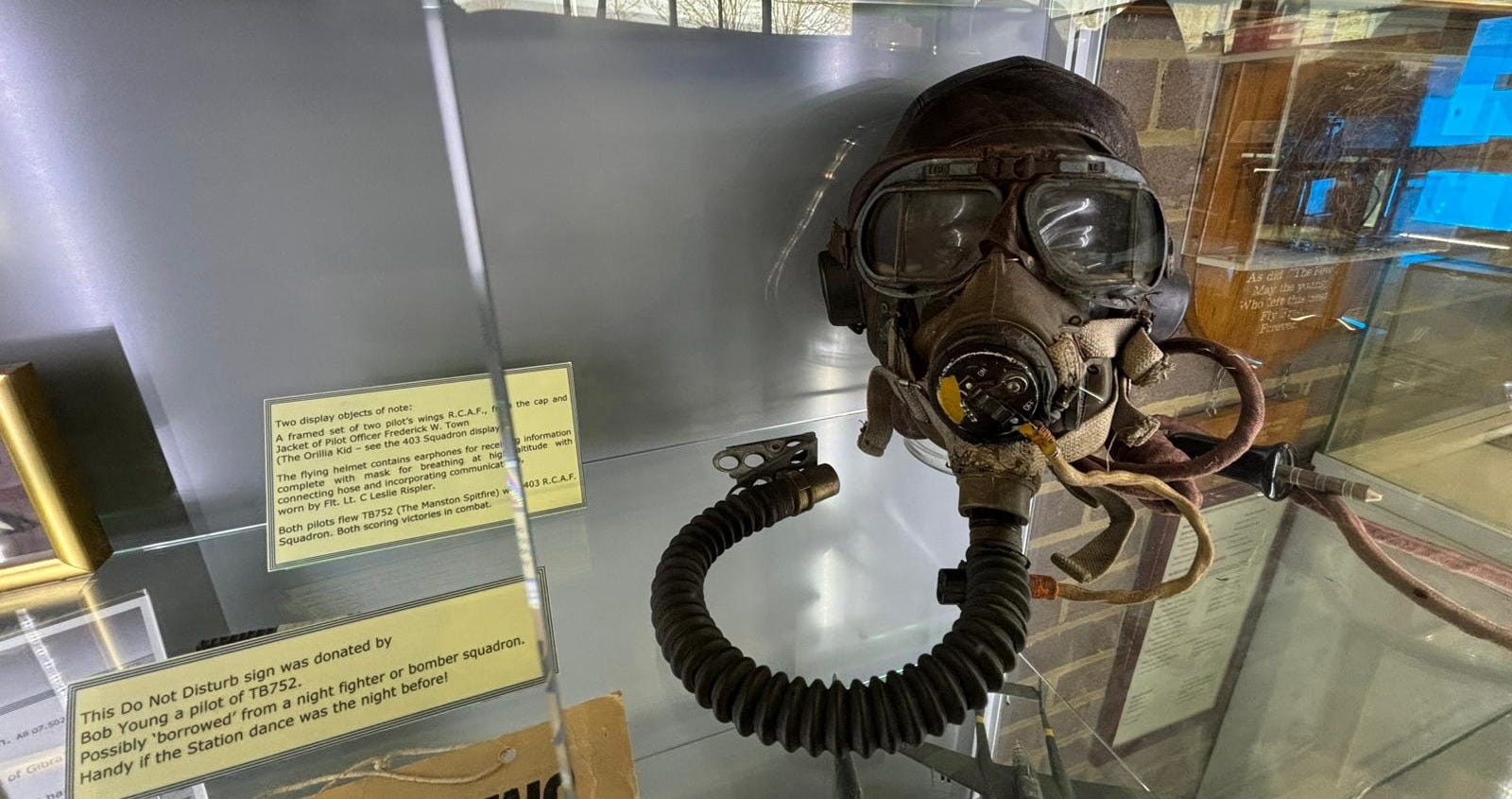
A uniform displayed behind glass carried the wings of a Royal Air Force pilot stitched above the breast pocket. Beside it hung photographs of young airmen smiling awkwardly in black and white images. Many of them never returned from the skies they defended.
One framed display told the story of The Orillia Kid. The nickname of a pilot connected with this particular aircraft and squadron history. Around the photographs hung squadron badges letters and fragments of personal memory. War reduced to human scale.
On a nearby shelf a carefully crafted model of a Lancaster bomber sat against a blue background. Four propellers. Long wings. The aircraft that carried Britain’s bombing campaign across occupied Europe. Even as a model it looked powerful and solemn.
Back beside the Spitfire the museum staff had placed the aircraft’s weapons beneath the wings so visitors could see the full arrangement. Bombs mounted centrally under the fuselage. Machine guns that once lined the wings. Ammunition belts feeding through the mechanisms. The cold tools of destruction that paradoxically became instruments of national survival.
It is difficult to stand in such a place and not feel both pride and unease.
Pride because the Spitfire became something more than a machine. It became a symbol. During the Battle of Britain in 1940 when the Luftwaffe attempted to destroy Britain’s air defences the Spitfire represented resistance. Winston Churchill’s famous words in the House of Commons still echo through history.
Never in the field of human conflict was so much owed by so many to so few.
Yet unease because museums are quiet places. They preserve memory but they also remind us that the conditions which produced these machines were once very real.
As we continued walking around the aircraft the sunlight shifted through the windows and fell across the polished floor beneath the Spitfire’s wings. The aircraft looked almost alive. The curved metal surfaces glowing faintly in the afternoon light.
Outside the museum spring continued unfolding peacefully. But beyond these walls the world has once again grown uncertain.
Across Europe the sound of war has returned. Russia’s invasion of Ukraine has reopened questions many believed were settled at the end of the Cold War. Military alliances are strengthening. Defence budgets are rising. Fighter aircraft once again patrol contested skies over eastern Europe. Analysts at organisations such as the Royal United Services Institute and the International Institute for Strategic Studies warn that Europe is entering a period of prolonged strategic tension.
The Spitfire remains a relic of another era but its meaning has not faded.
The aircraft represented a moment when technological innovation courage and national resolve converged in defence of democratic societies. During the war the Spitfire evolved through more than twenty major variants adapting constantly to new threats. Its Rolls Royce Merlin engine later replaced by the more powerful Griffon gave it extraordinary speed and climbing ability. Pilots praised its responsiveness describing it as an aircraft that seemed to anticipate the movements of its pilot.
Historians including Stephen Bungay in The Most Dangerous Enemy and Alfred Price in Spitfire A Complete Fighting History have written extensively about how the aircraft shaped the air war over Britain and later over Europe North Africa and the Pacific.
Standing beneath its wing in that quiet museum hall the machine seemed both ancient and strangely current.
Because history does not remain safely locked behind glass.
The men who flew these aircraft were often in their early twenties. Some even younger. Many came from across the Commonwealth. Canada New Zealand Poland Czechoslovakia South Africa. They formed squadrons that carried accents from across the world into the skies above Britain.
Their aircraft defended not only territory but the fragile idea that open societies could survive aggression.
Today the Spitfire sits preserved polished and admired by visitors on quiet weekends. Yet its legacy carries an unspoken warning.
Peace is rarely permanent.
The same skies once crossed by Spitfires may again see aircraft defending European airspace. Not these machines perhaps but their descendants. The technologies have changed. The stakes have not.
As we left the museum and stepped back into the mild spring sunlight the quiet countryside seemed almost impossibly calm. Birds moved through the hedgerows. The sky stretched wide and clear.
But behind us inside that modest building stood a reminder of what Britain once faced and overcame.
A slender aircraft of aluminium and rivets.
The Spitfire.
Not merely a museum piece but a symbol of the moment when a nation stood on the edge of darkness and refused to fall.