


About three weeks ago an American friend of mine, John, came to visit me and told me there was a brilliant breakfast place in Margate, a place with the mood of the 1960s and 1970s still lingering in the air, and that he would much rather we go there for breakfast than anywhere else. So we did.
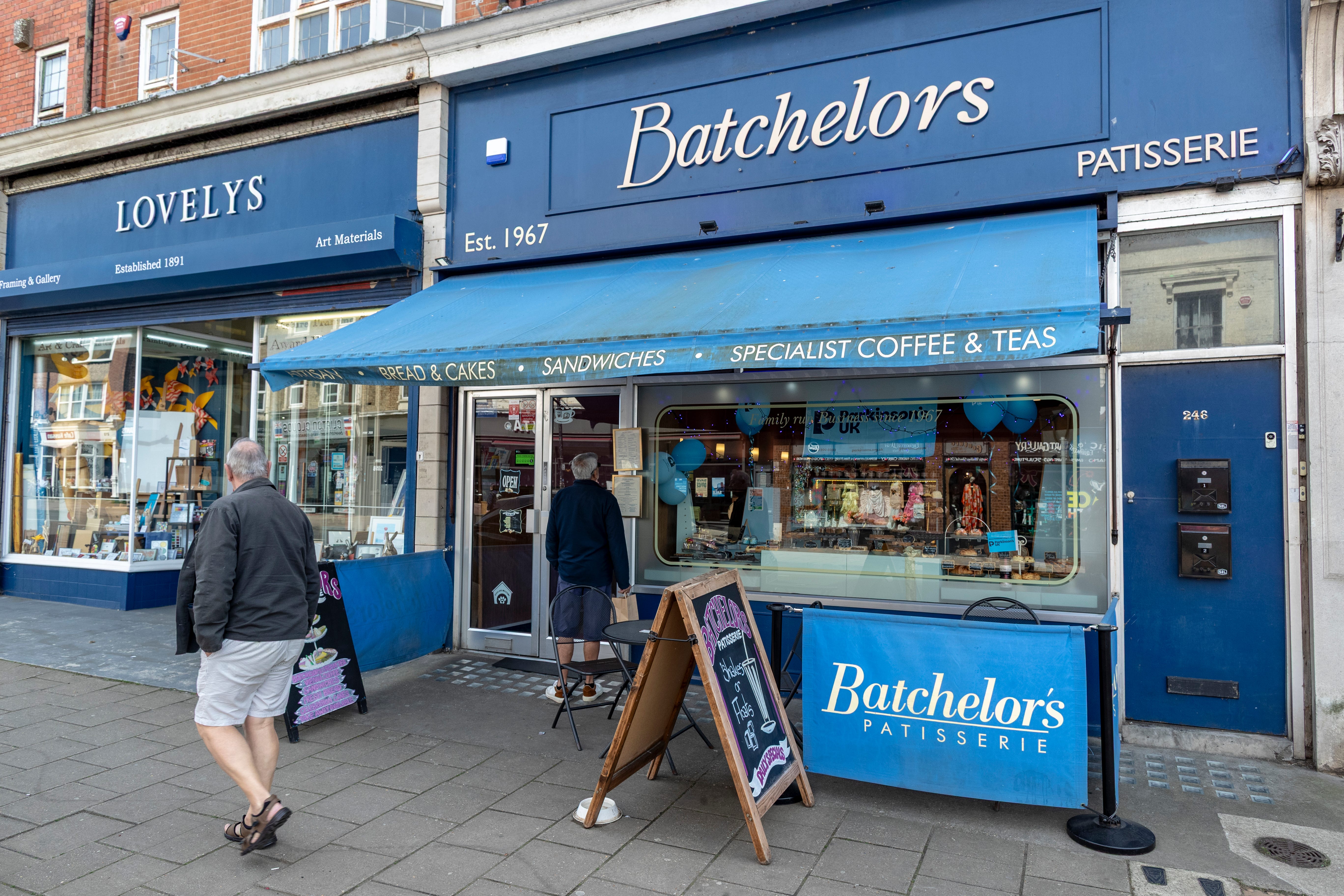
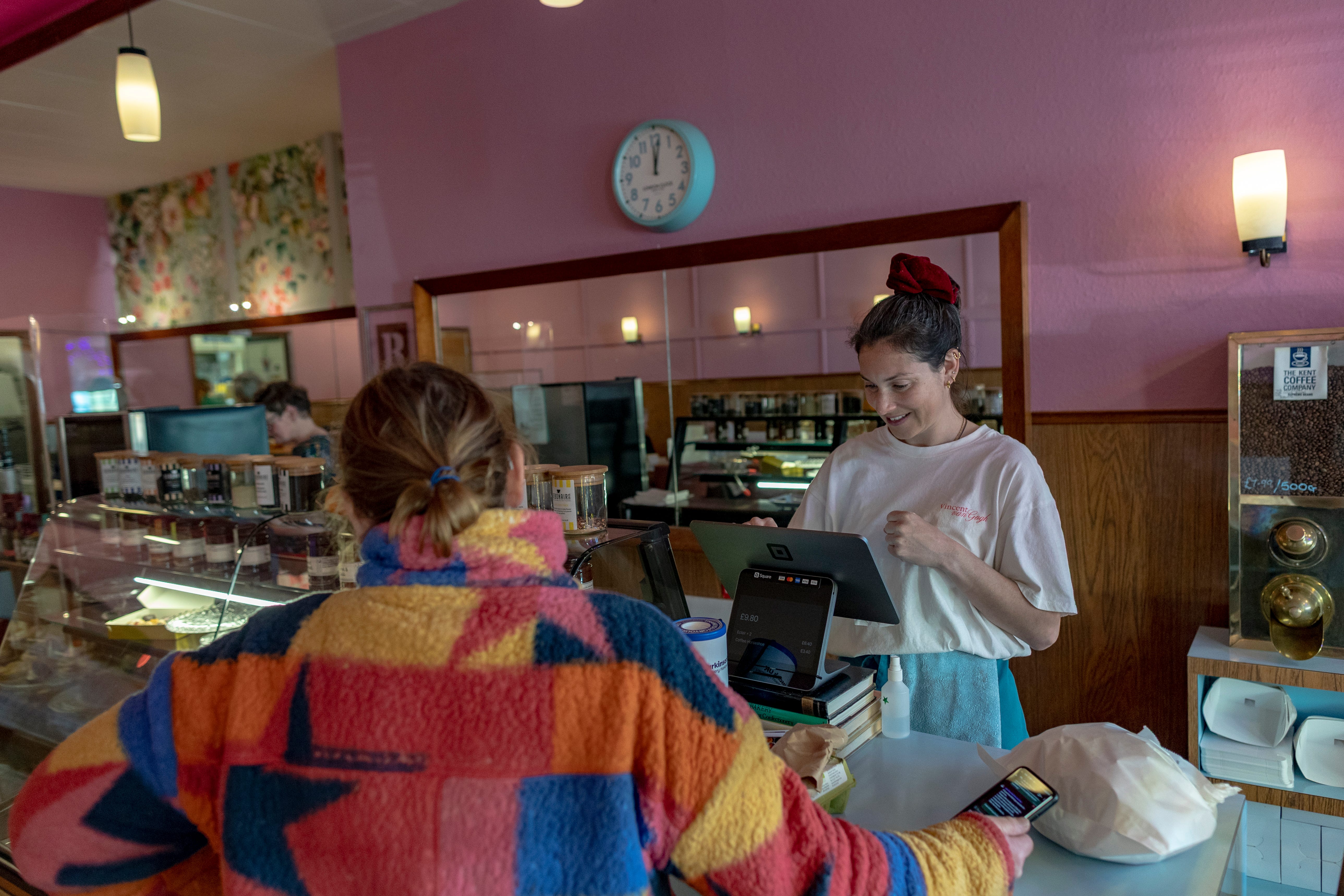
Upon entering Batchelor’s Patisserie in Margate, we were greeted first not by a person, but by colour. The walls were pink. Not a timid pink, nor the sort of decorative pink that apologises for itself, but a warm, full pink that gave the room an immediate softness, as though one had stepped indoors not merely out of the weather, but out of the hardening tempo of the street. Above us ran a vivid strip of rose light around the ceiling, glowing from the edges like a memory refusing to dim. Pendant lamps hung down in neat intervals, creamy and modest, casting a gentle, domestic glow. There was a wall clock, a little old fashioned and reassuring, as though it had been put there not simply to tell the hour, but to remind people that time, in a place like this, ought to move at a more civilised pace.
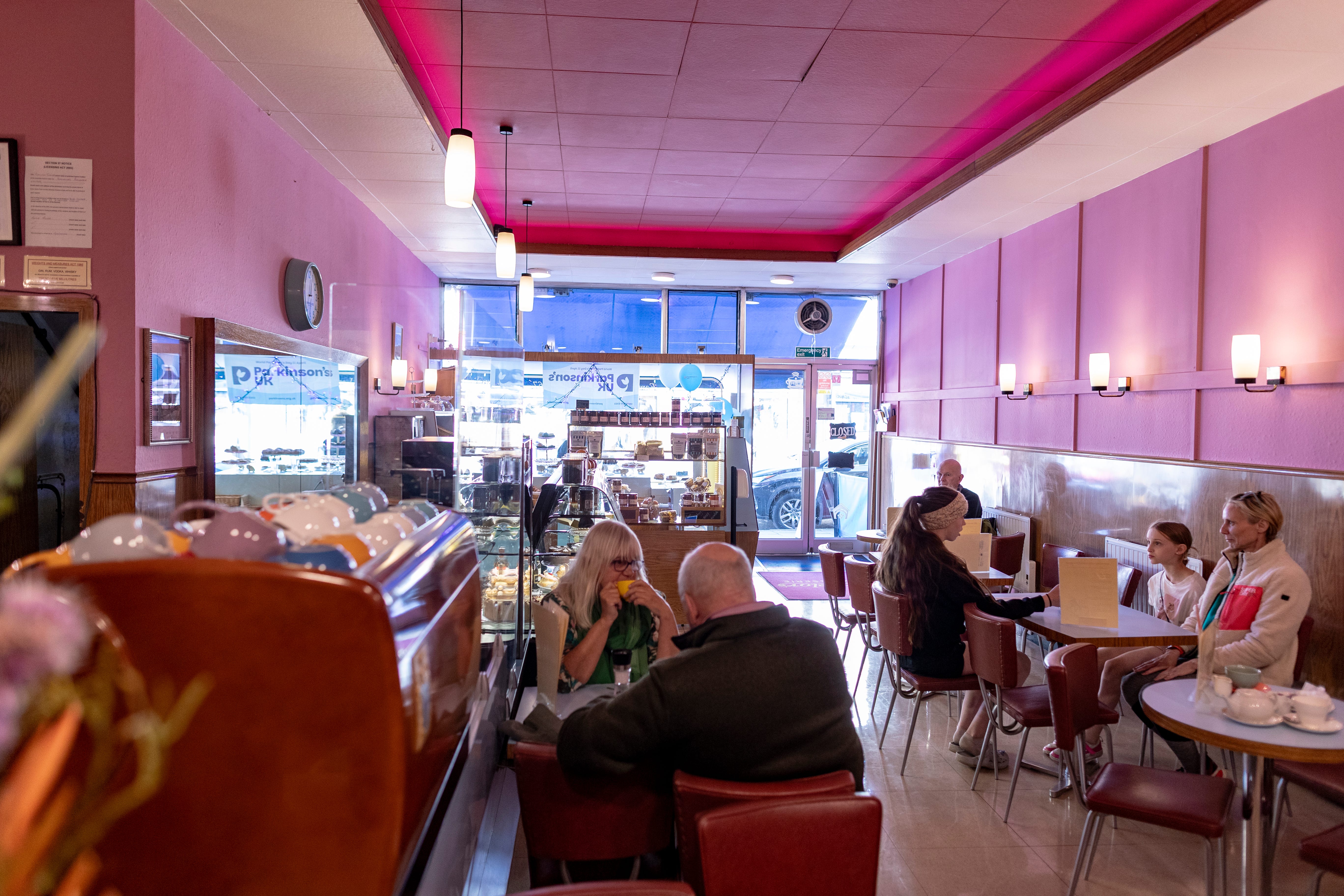
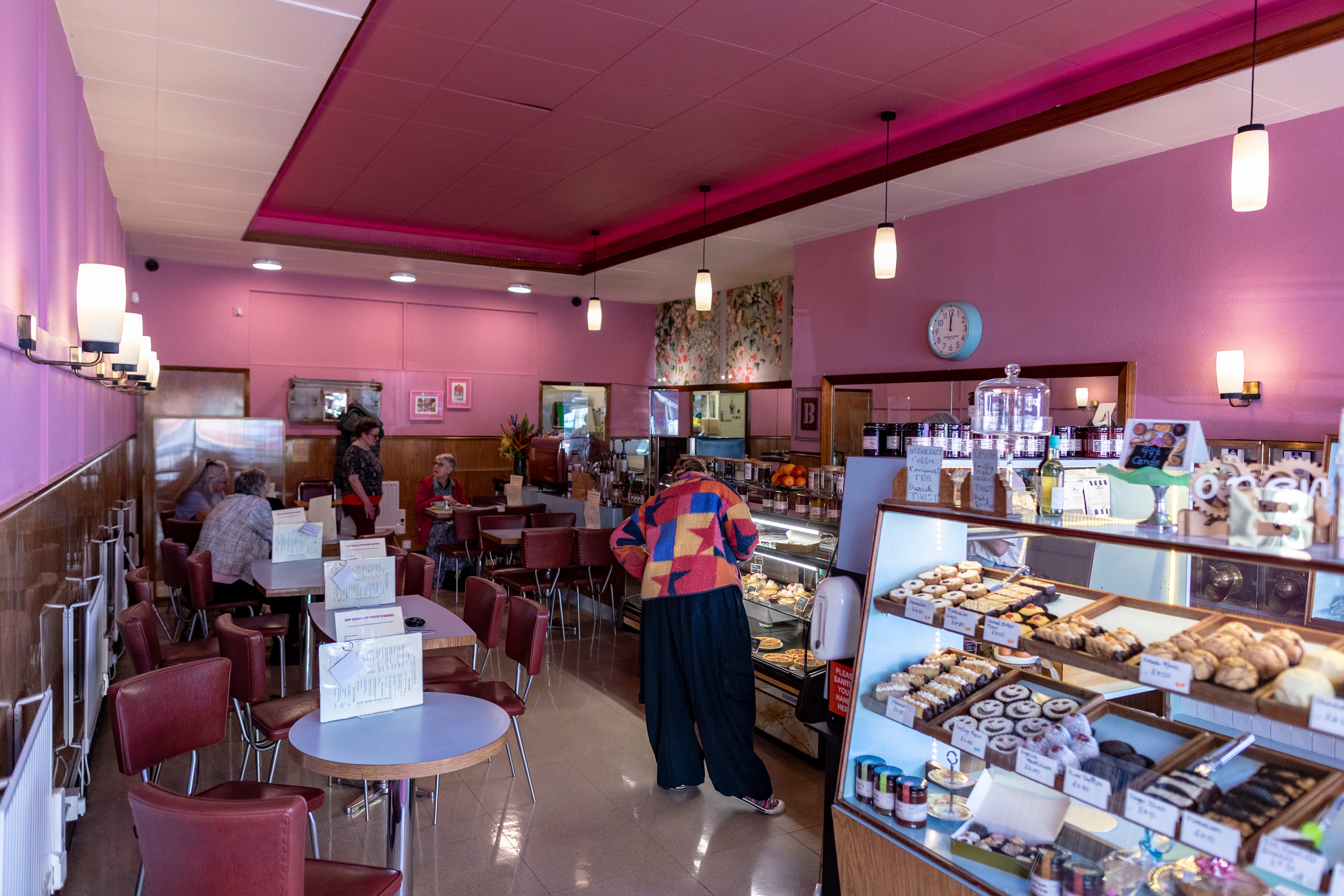
The room was full of small details that made it feel less like a business than a place that had acquired its soul over years of use. There were polished glass counters with cakes sitting in orderly temptation. There were shelves with jars and packets, chalkboard labels, coffee and tea arranged with the sort of practical pride that belongs to people who believe in the dignity of a proper counter. There were vintage looking chairs in a dark, wine red tone, close enough together to suggest conversation rather than privacy. Near the entrance lay a bright mat bearing the shop’s name in pink and gold, like a little theatrical flourish at the threshold. The front windows looked out onto the street, but inside the place seemed to hold its own weather. Outside was Margate. Inside was Batchelor’s, with its own light, its own etiquette, its own clock.
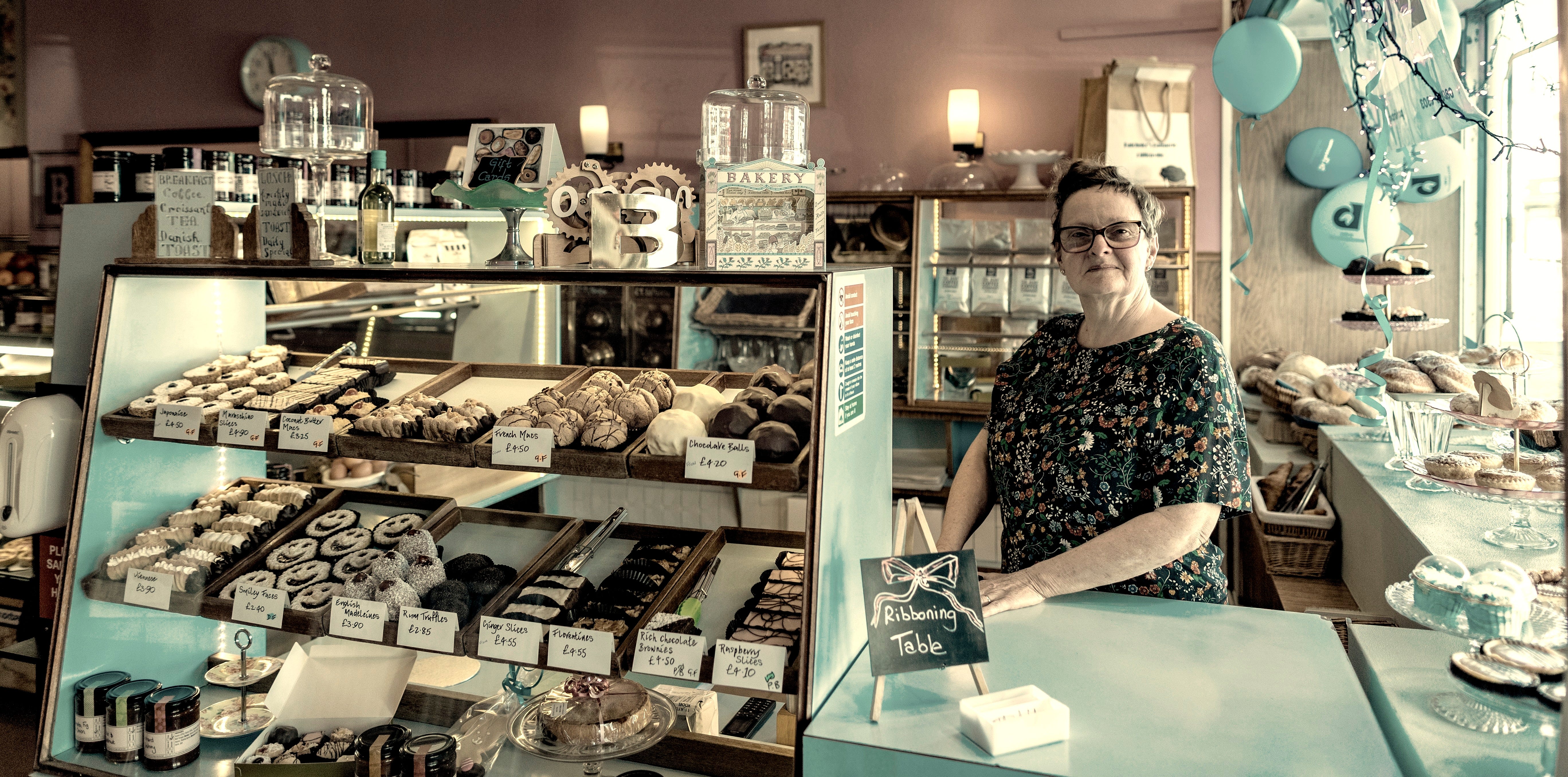
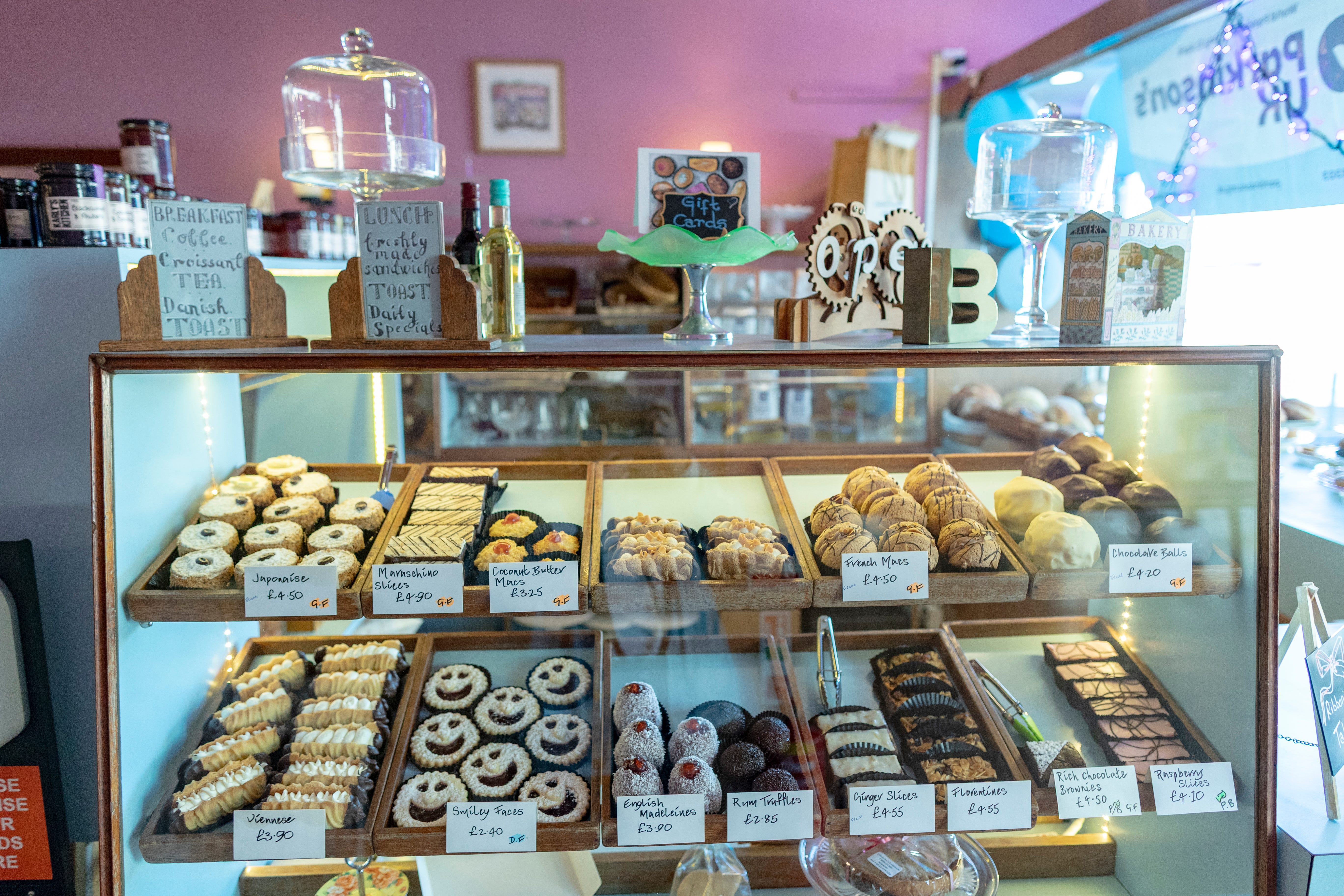
Then there were the cakes. They sat in the cabinets not as anonymous goods but as characters, each with a small handwritten sign and a distinct bearing. Chocolate balls in dark and white coatings. Maraschino slices. Coconut butter macs. French macs. Smiley faces. Rum truffles. Viennese fingers. Florentines. Ginger slices. Rich chocolate brownies. Raspberry slices. Japanese cakes. There were rows and rows of them, each one appearing to belong not merely to a menu but to a lineage. They looked as though they had been made by hands that knew the difference between abundance and vulgarity. Nothing was showy. Everything was inviting.
Our breakfast, when it came, carried the same calm confidence. The scrambled eggs were soft and yellow and unpretentious, the toast thick and generously buttered, the greens bright at the edge of the plate. Later there was coffee, black Americano, deep and steady, and cake served on china that looked as though it had lived another life before arriving here. Even the plates seemed to understand the room. They had floral patterns and a faint sense of ceremony about them, as though to eat from them one ought to sit up a little straighter and pay attention.
The waiter who came to greet us and ask what we would like to drink and eat was Gillian. She moved through the place with the ease of someone who did not merely work there, but belonged to it and was, in some important sense, part of its grammar. There are people who serve, and there are people who set the emotional temperature of a room. Gillian belonged to the second category. She had a way of speaking that made ordinary hospitality feel faintly literary, as though politeness itself could still be practised with style. At one point, when I was fussing with my notebook and trying to remember whether to finish my breakfast or begin my questions, I mentioned that I am not very good with names, only with moments.
“My brain is used to remembering only moments of talking to people for the purpose of work,” I told her.
Twenty years in the job of war reporting will do that to a person. Back in the day, technology was not always there to rescue you. You had to take notes.
You had to remember. Gillian listened, made a small sound of recognition, and when she saw that I was preparing to talk too soon and eat too little, she smiled and said, “Can I leave you to finish your breakfast first? It would give me great delight to know that you had enjoyed the whole entirety of your plate.”
There was in that sentence the whole place. Not performance. Not branding. Not the synthetic friendliness of modern service. Something older and better than that. A care for language. A care for ritual. A care for the plate in front of you.
After eating and observing the room, I asked her, “Would you be willing to talk to me if I came to visit you later someday to discuss the lovely place you run? How did you come up with this idea?”
She suggested that I email her, and so I did. We agreed to meet in the week we are now leaving behind, and when I returned, notebook ready and camera hanging quietly by my side, here is what Gillian told me.
She is from up north, from Newcastle, and came to this corner of Kent because life, work and fate kept drawing her back. Stuart’s work had repeatedly brought them here, she said, and after a while it began to feel less like coincidence than instruction.
“I quite believe in fate,” she told me. “Things just kept saying, this is where you’re meant to be and where you’re meant to live.”
They settled not in Margate itself at first, but in St Peter’s, Broadstairs, just a couple of miles away, in that tight little triangle of east Kent where one town leans into the next and local identity can be both fiercely particular and gently shared.
For years she worked for other people. She was, as she put it, “always a housewife and a part time clerk and a part time supermarket worker”, while Stuart had been in governmental education.
Then came a health scare, and with it one of those clarifying shocks that can reduce a life to its true question. How much longer do you go on doing what is safe merely because it is familiar?
“Life was just too short,” she said. “It was time to do something we’d talked about for decades, of having our own business.”
Batchelor’s was already established by the time they came upon it. They had known it first as customers, the way many others have known it. A place to come when one wanted something a little bit special. One day, after looking at another local business that “just didn’t tick any boxes”, they came into Batchelor’s for tea and cake, ran into a friend, and learned that the place was for sale. The owner at the time, Richard Beech, was himself the apprentice of the previous owner. The inheritance of the shop had already passed once through hands that learned before they led. Gillian and Stuart phoned Richard, came to see him on the Sunday, and by the Monday they had put in an offer and bought the business.
“So it was all really fast,” she said, smiling with the faint disbelief of someone who still cannot quite believe the speed with which a life can tilt.
The training she received before taking over was brief and intense, perhaps six weeks. Then the real education began, the sort one only acquires by opening the doors in the morning and hoping that courage will arrive before the first customer.
“Absolute sheer terror,” she said, when I asked what it felt like. They had sold everything to buy the place. Later they sold the big house they had been half living in and bought a boat. They live on a boat now. “We’ve invested everything into this,” she said. “So, yeah, it was terrifying.”
That terror, as she described it, did not disappear with experience. It merely changed shape. In the early days it was the fear of having wagered everything. Now it is the knowledge that reputation, however venerable, cannot be treated as self sustaining. Batchelor’s has been here since 1967. That date matters. You feel it in the furniture, which Gillian told me is original. You feel it in the proportions of the room, in the fact that the place has not been gutted and reimagined by people who believe heritage is something to be mimicked rather than lived with. Yet survival, she said, depends on balance.
“You can’t rest on Bachelors reputation,” she told me. “You’ve got to constantly keep up with the new Cliftonville and Margate, ’cause it’s changing.”
Not reinventing, she said. Refreshing. New paint on the walls. A small amendment to ingredients. A modern touch without a betrayal of ethos.
That distinction matters in Margate, a town that has for years been narrated through the vocabulary of change, revival, displacement and return. In Batchelor’s, change does not arrive as spectacle. It appears more subtly, in the widening of dietary options, in the careful communication that gluten free is not a recent concession to fashion but something long embedded in the shop’s baking traditions. Many of the recipes, Gillian explained, have always relied less on wheat flour and more on ground almonds and hazelnuts. Vegan options have been introduced. New flavours come in. The spirit remains.
“Keeping the quality, but putting a little bit of a modern twist on things,” as she put it.
When I asked about the storms that had passed through Britain and what they had done to the business and its customers, Gillian spoke first not of politics but of people. Covid, she said, was the greatest storm for Batchelor’s. Many of the regulars were elderly. Some had lived long enough for this tea room to become one of the last fixed points in their social lives.
“Whose only social time was here,” she said of some customers.
During the lockdowns, the shop kept home phone numbers and rang people up.
“Do you need anything? We’re out delivering bread and things. Can we bring you something?”
A café is often spoken of lightly, as a convenience, as leisure, as a treat. But in certain communities it is something closer to informal civic architecture. A place where loneliness is quietly interrupted. A place that notices your absence. A place that knows your usual. Batchelor’s, in Gillian’s telling, saw itself as having obligations to the people who had sustained it for decades. The relationship went both ways.
Brexit entered the conversation later and in a more material register.
Many of the recipes are continental, she said, and the cost of ingredients has “tripled, quadrupled and hasn’t come down”.
The arithmetic of baking became harsher. Prices had to rise. Yet she spoke about that with evident caution, not as someone pursuing gain but as someone trying not to pass too much pain on to the community she serves.
“Not to make a grand profit,” she said, “but just enough so the business can survive.”
And the community, perhaps recognising that ethic, remained loyal. People might come less often through the week, she said, but they still come. There was something almost moving in the modesty of that fact. In hard times, people do not entirely relinquish the places in which they feel like themselves.
Seasonally, the business shifts, but not dramatically. Summer visitors arrive. Locals go away. Airbnbs bring in new faces. Easter and spring bring movement. Christmas remains more domestic. But Batchelor’s, Gillian insisted, is not merely a summer place for tourists. To the best of her knowledge, there is nowhere else like it in the south east. It is a local institution that also happens to be discoverable by outsiders.
When I asked which cake people want most, she smiled in the manner of someone with too many favourites to choose from but enough practical experience to do so anyway. Pre Brexit, she said, it might have been the chocolate truffle torte. Across the board, over time, perhaps the Japanese. It was the coffee Japanese I had tried on my first visit, and I returned to it when I came back. It is a curious thing, dry where one expects wetness, delicate, crumbly, restrained, a cake that does not seduce by force but by texture and surprise. Gillian seemed pleased that I liked it. Her own favourite is a Nuss Torte, rich with hazelnuts, walnuts and caramel in a buttery sweet pastry, beloved by her because it is not too sweet and carries a faint savoury note from the nuts.
The clientele, she said, is largely semi retired and retired, along with younger families who came as children and now wish to pass the experience on to their own sons and daughters. That sentence opened the whole room for me in a different way. A café is one thing. A handed down habit is another. To bring a child where one was once brought is to say, without quite saying it, that continuity is still possible. Gillian told me of a man now in his late eighties or early nineties who started coming as a newlywed and still comes in as a widower for his breakfast. That detail sits in the mind with unusual weight. Newlywed to widower, and the place remains. Few institutions in modern Britain can claim that sort of quiet continuity.
Even younger customers, though not yet arriving in packs with friends, do come in on their own to do artwork or university work with coffee and cake and a notebook. It is not difficult to imagine why. The place invites a certain kind of loitering, the good kind, the kind in which a person is allowed to think, observe and belong without being hurried.
Later, while I was there, I also spoke to Jackie, who was among the regular customers having her lunch time. Her presence had about it the easy familiarity of someone who knows the staff well enough not to perform her regularity. She has lived in Margate for over thirty years, having come down from Mid Sussex for work originally as a librarian, and later worked as a teaching assistant in a primary school before retiring about seven years ago. When I asked how she would describe Margate after three decades, she spoke most readily not in abstractions but through Northdown Road, through what had changed and what had gone. A hardware shop. A bookshop. Useful places. Not corporate, she said, but necessary. The vocabulary of local loss is usually made of nouns before it is made of theories.
As for Batchelor’s, she could not quite remember the first time she discovered it, only that she has been a regular for over ten years and remembers when the layout was slightly different, when there had been a counter by the window. That is how people often remember beloved places. Not by calendar year, but by furniture and placement, by where things used to sit.
“It’s just so friendly in here,” she told me. “The staff are brilliant, and I call them as friends now. And I’ve made a lot of friends in here.”
That last sentence was not said for effect. It landed with the simple authority of lived truth. She comes most days, unless she has to go somewhere else.
“That’s my vice,” she said, before correcting herself. “Well, it’s not a vice ’cause it’s lovely.”
She does not smoke. She does not drink. She comes for coffee, for food, for company, for rhythm. Her routine in retirement now begins more slowly because of back problems. It can be an effort to get moving, she said, but coming up here matters because she knows she will get a welcome. That line, too, says more than it appears to. In later life, routine is not trivial. It is often one of the last working forms of self rescue.
Her tastes have changed a little following a diagnosis of higher cholesterol. Now she has things like spelt toast with crunchy peanut butter, or on Thursdays spelt toast with scrambled egg and avocado. During the week she may still have a piece of German apple cake or the apple strudel, which she described as really good. The affection she expressed for the food was threaded through with something larger than appetite. It was trust. The knowledge that a place can adjust with you as your body changes, that one can still belong even as one must begin to choose differently.
When I asked what the best season is to be there, she hesitated, not because she had no answer, but because the place seems to gather atmosphere differently across the year. She mentioned November and the armistice remembrance, when Stuart, who used to be in the army, helps create a quiet and reflective mood. She mentioned Christmas and Easter, wonderful for customers, punishingly busy for staff, with orders mounting because everything is baked on the premises. In other words, there is no dead season in the emotional life of the place. Only different registers of meaning.
Stewart prepares sourdough at Batchelor’s Patisserie in Margate, using a slow fermentation process of up to eighteen hours to develop flavour and texture, with the dough rested overnight to support natural bacteria. (→ All rights reserved.)
And if someone had not yet discovered Batchelor’s?
Jackie’s answer came in the form of an almost incredulous invitation.
“Why haven’t you tried Bachelors? You need to try Bachelors. It’s really a super place for food and company.” Food and company. Not food alone. Not ambience alone. The phrase is exact.
What becomes clear, sitting in Batchelor’s and listening first to Gillian and then to Jackie, is that the place offers something unfashionable and therefore increasingly rare. It offers steadiness without dullness. Character without gimmick. History without stiffness. It is not a museum of old Margate, nor is it trying to become a sleek emblem of new Margate. It is doing something more difficult. It is remaining itself while allowing time to pass through it.
That may be why the room feels so alive. The pink walls are not simply decorative. They hold years of mornings, chatter, silences, sugar, sorrow, first visits, last visits, cups carried across tables, and people seen through different stages of their lives. The original furniture remains not because nostalgia is marketable, but because use has consecrated it. The handwritten labels in the glass counter are not branding assets. They are signs that hands still matter. Even the way Gillian speaks to customers, the cadence of her phrases, the touch of ceremony in the ordinary, seems part of a longer tradition in which hospitality was not yet flattened into transaction.
When she spoke of Batchelor’s near the end of our conversation, Gillian struggled, for once, to find the words.
“I can’t put it into words how much this is a part of something,” she said. “Because it’s so established, the history it’s got, if the walls could speak.”
Then she stopped, started again, and admitted that she could not entirely explain herself. But perhaps that is because the deepest affections for a place are often hardest to articulate to the person standing inside it every day. The people who belong to a place do not always narrate it best. They embody it.
As I prepared to leave, she asked whether I was ready for that drink. I ordered a black Americano and, yes, another Japanese cake, the coffee one again because the lemon can provoke acid reflux in me. She knew at once what I meant. Then I asked if I might make some portraits of her. She refused with a kind of amused resistance.
“Oh, no, I don’t want my photo taken,” she said. “Am I?” she added, when I told her she was a unique character and that people would love her. Then, with perfect instinct, she escaped the compliment by returning to the practical. “Let me go and get your cake first.”
And that, perhaps, is Batchelor’s Patisserie in Margate. Not merely the pink walls, though they are memorable. Not merely the cakes, though they are worth travelling for. Not merely the furniture from 1967, the handwritten signs, the coffee, the breakfast, the neat glow of the cabinets, the rose light at the edge of the ceiling, the quiet theatre of the front room, the sense that the clock on the wall is keeping time for more than one generation. It is, rather, the human arrangement of all these things. A place where a woman from Newcastle and her husband risked everything on a leap of faith. A place where a retired teaching assistant comes most days because she knows she will be welcomed. A place where customers become friends, and friends become part of the architecture. A place where someone in his nineties still comes for breakfast as he once did when newly married. A place where the staff phone elderly regulars during a pandemic to ask whether they need bread. A place where people come in for tea and cake after disappointment and accidentally find the next chapter of their lives.
You go there for breakfast, as John and I did, perhaps because a friend tells you there is a brilliant place in Margate with the feel of the 1960s and 1970s. You enter because of curiosity. You notice the pink first. Then the cabinets. Then the lamps. Then the room begins to disclose its true subject, which is not nostalgia at all, but fellowship. By the time the coffee is set down and the cake arrives on its floral plate, you realise that Batchelor’s does not simply feed a town. In its own modest, enduring, utterly human way, it helps hold one together.
