


It is Saturday and as I am exploring Kent in my editorial plans to establish the Kent Chronicles and find its voice and place in the region, I casually stumble upon a traffic light in a window and it says “Walk, Don’t Walk”. It triggers my attention the way small curiosities sometimes do in unfamiliar streets, the way an unexpected object can interrupt the rhythm of a quiet town. I am in Deal, walking along a row of brick buildings softened by a pale coastal fog. The street is calm, the kind of calm that belongs to towns which know the sea well and have learned patience from it. Cars are parked along the kerb, the houses tall and narrow, their Victorian brickwork holding a certain stubborn dignity.
But there it is again in the window. A pedestrian traffic light glowing with its contradictory instruction. Walk. Don’t walk. An invitation and a warning in the same breath.
Curiosity wins. I walk.
The building itself looks almost like a converted workshop, a brick structure with a yellow door tucked into a small courtyard just off the pavement. A sign reads “Gallery”. Above it hangs another sign with the same mischievous phrase I saw in the window, “Don’t Walk Walk Gallery”. The architecture feels improvised rather than curated. A black metal staircase clings to the exterior wall like a skeletal ladder to somewhere private. Through the window sits a bright yellow smiley face ball watching the street as if amused by those of us passing by.
Deal, it turns out, hides things in plain sight.
From the pavement the place feels slightly mysterious. A narrow entrance leads inside. A black door stands open. Inside, a small corridor begins.
The hallway is barely wider than two people standing shoulder to shoulder. Its walls are textured and imperfect, the paint chipped in places revealing layers of earlier lives. Framed artworks line the walls, crowded but carefully placed. Above them hangs a traffic signal mounted to the wall, its arrow glowing green as if pointing deeper inside the gallery.
A red sign leans on the floor.
“Pedestrians Be Nosey.”
It is impossible not to laugh.
The humour disarms the visitor immediately. The message is clear. Come in. Look around. Ask questions.
A large framed print dominates the right wall. A boy in a striped shirt pulls another smaller child upward from a black void, the composition playful yet faintly unsettling. On the opposite wall hangs a collage of musicians and pop culture icons arranged like a mosaic of music history. The corridor itself feels like a prelude, a threshold between the street outside and something more layered beyond.
The corridor opens into the gallery proper.
The room is intimate but alive with objects. Paintings lean against walls, framed prints hang salon-style across the space, collages and photographs compete with sculptures and odd artefacts arranged on shelves. Music posters cover one wall. A record player sits beside stacks of vinyl. A glowing amber traffic signal lamp stands in the middle of the room like a strange sculpture.
Several visitors are standing in conversation. The atmosphere feels less like a formal gallery and more like someone’s living room during an unusually thoughtful gathering.
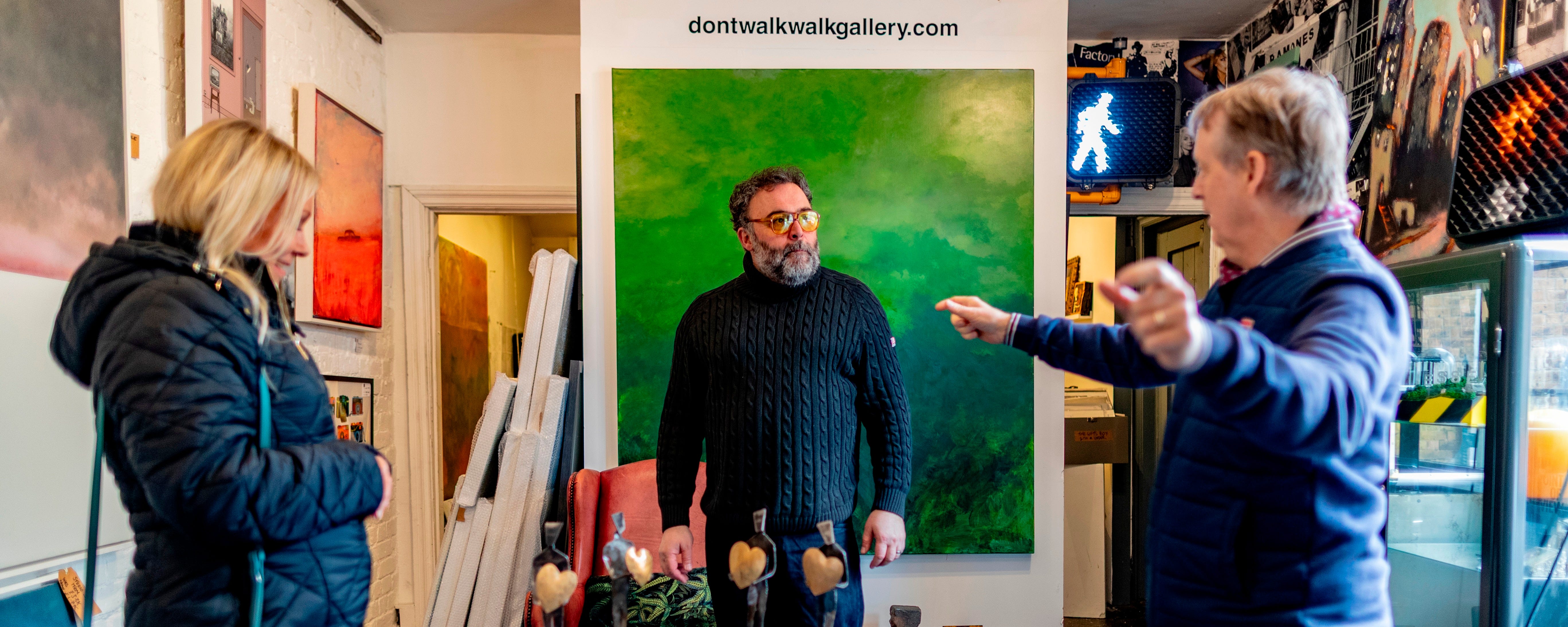


This is where I meet Ned.
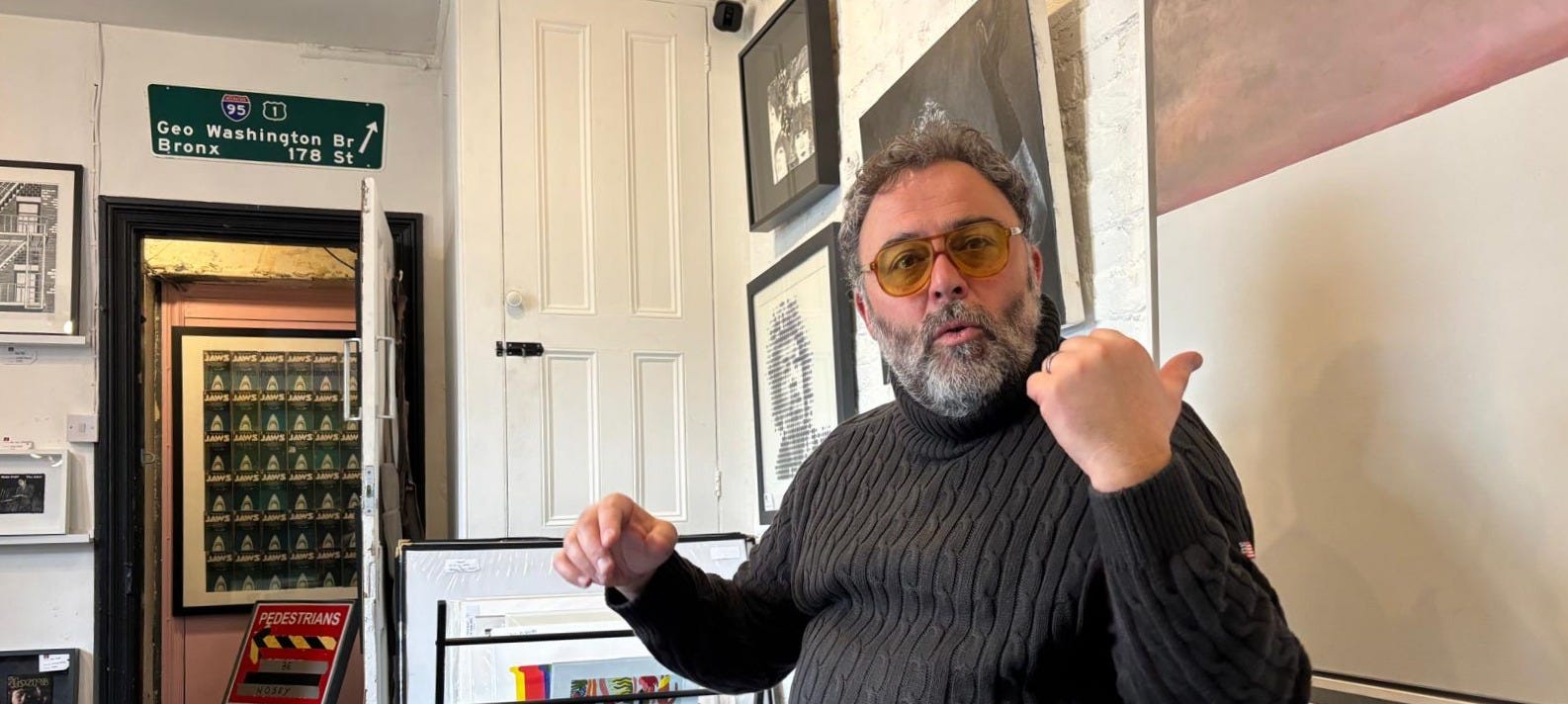
He is seated casually, wearing yellow-tinted glasses and a dark sweater, his posture relaxed but his presence unmistakably engaged. The sort of person who speaks with his hands and listens with his entire face. When he talks, he gestures behind him toward the artworks as if they are collaborators in the conversation.
We talk briefly that Saturday. Enough to sense that this place carries a story deeper than the narrow corridor suggests.
We agree to meet again Monday for a proper interview.
When I return on Monday the weather has shifted into that familiar coastal grey which seems permanently suspended between rain and sunlight. Inside the gallery the warmth remains. This time another figure is present.
Henry.
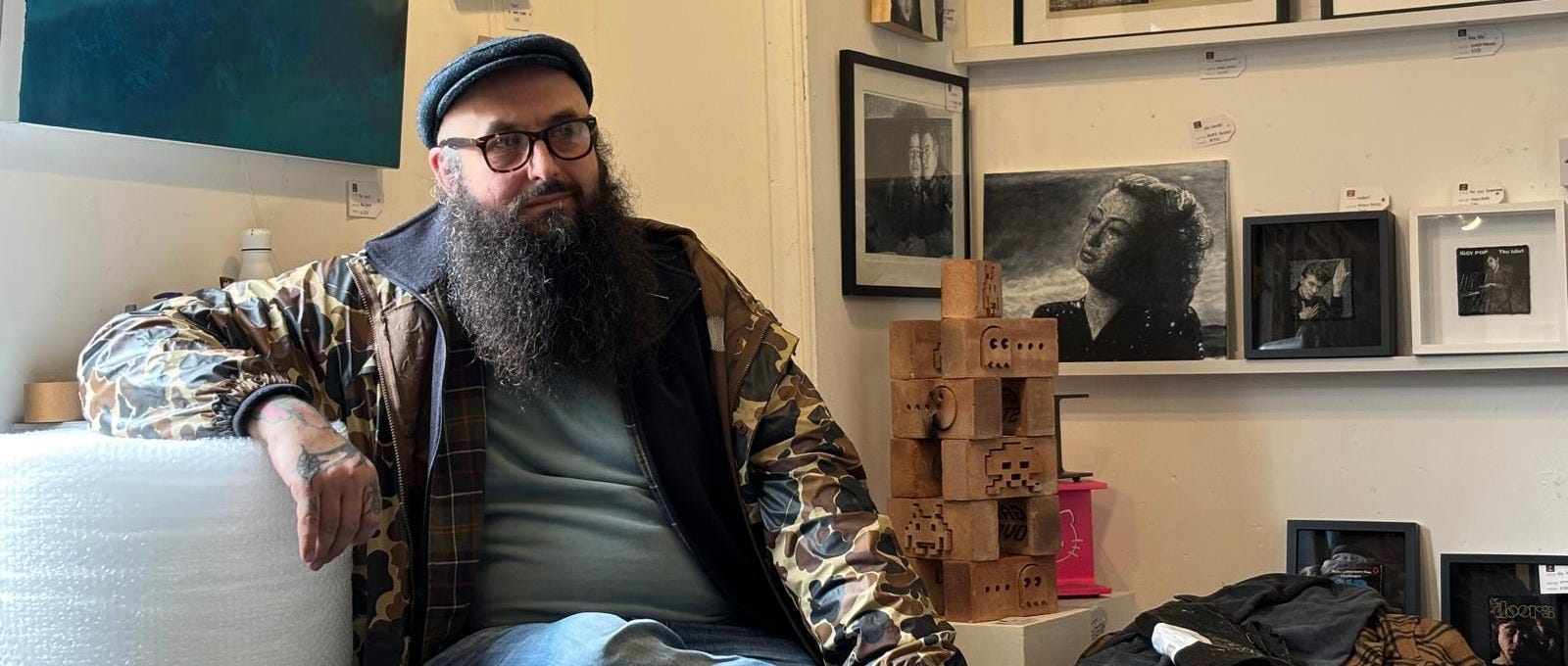
He sits comfortably in an armchair near the window, wearing a flat cap and a long beard that gives him the appearance of someone who might easily drift between artist, philosopher and pub regular without contradiction. Behind him hangs a quiet arrangement of framed photographs and abstract works. A painting of two chairs beside a swimming pool catches the winter light from the window.
Henry watches the room with a calm attentiveness. Between the two of them the gallery has the feeling of a shared experiment. When the conversation begins Ned leans forward slightly as if introducing himself not just to me but to the room.
“So let’s talk about who is Ned.”
He pauses, amused by the question himself.
“Who is Ned? Well Ned is part of me. It’s not all of me. It’s part of me.”
He explains that his journey into art began in London where he studied painting at Wimbledon.
“I did a master’s degree in fine art painting. Before that I’d been painting these quite large abstract skyscapes and things like that.”
But the academic world of contemporary art had other expectations.
“Within my first week at Wimbledon the tutor did a crit with me and he was like, why are you painting like it’s the turn of the fucking century. We’ve seen Turner. We’ve seen Rothko. Why aren’t you doing something more contemporary.”
The remark forced a shift.
“So I came back to my hometown which is Dover and I took four hundred photographs of Dover. And I started to make paintings about what it was like growing up in a seaside town.”
Not romantic seascapes. Everyday infrastructure.
“I started looking at board stools, electricity pylons, bus stops. Things that were just everyday and normal. I tried to find a beauty in ordinary and make the ordinary extraordinary.”
This is where the story becomes particularly interesting. Because Ned is not exactly Ned.
“My nickname at school was Ned,” he explains. “So I said right that’s Ned and this is Neil.”
Neil became the other artistic identity.
“So Neil was doing the prisons, the motorway service stations, the work that had social commentary on growing up in a seaside town.”
The paintings captured the quiet melancholy of neglected spaces. Places that most people drive past without seeing.
“But the Ned work would always sell because it had an aesthetic beauty people could live with. Not many people want a painting of Strangeways Prison on their wall.”
One of Neil’s works became unexpectedly important.
“It was a painting called Shit Picnic.”
The title alone provokes laughter.
“It came from memories of my dad taking us on picnics around Kent. We’d sit under an electricity pylon in some field somewhere. Grey sky, green grass, blue picnic blanket and this massive pylon above us.”
The painting was submitted to the prestigious John Moores Painting Prize in Liverpool.
From three thousand artists fifty-two were selected. Tracey Emin and Peter Blake were among those who chose the works.
“The Moores family bought the painting,” Ned says. “That became a bit of a launch pad.”
But life rarely moves in a straight artistic line. Years later Ned was lecturing at the art college in Canterbury when redundancy arrived abruptly.
“My third child had just been born.”
To keep money coming in he began working for a neighbour who was a builder.
“Painting and decorating. Labouring.”
After a year the builder delivered a blunt but transformative piece of advice.
“He said I’m not being funny but I don’t really want to pay a hundred pounds a day to an overweight middle aged man getting out of breath running up stairs. He said I might as well have a nineteen year old.”
Ned laughs.
“Then he said there’s a place around the corner with a sign that says To Let on it. Why don’t you go open an art gallery.”
That builder was Big Darren. And that small offhand suggestion changed everything.
“I saw this little sign hanging on the window. It said To Let with a phone number.”
Ned called the number. The arrangement was simple.
“A gentleman’s handshake. No contracts.”
On March seventeenth two thousand and seventeen the gallery opened. The first night he took thirty pounds.
“I thought right. This is going to be difficult.”
But he had a plan.
He wanted something different from the polite seaside galleries filled with paintings of boats and seagulls.
“I wanted to do something counter. Something subversive.”
So he created a slogan.
“No beach huts. No boats. No seagulls.”
It was half joke, half manifesto. And crucially the gallery would not behave like a traditional gallery.
“I don’t like art galleries,” he tells me. “I don’t like going somewhere with white walls where you feel preyed upon.”
Instead the space would be layered with references.
Music. Film. Collage. Candles. Conversation.
“And always something funny in the hallway,” Ned adds. “Something that makes people laugh when they poke their head in.”
That red sign outside the corridor proves the point. Pedestrians Be Nosey. Henry enters the story shortly after. Ned remembers the first time they spoke.
“Henry walked in and his opening words to me were you need to get some Bitcoin.”
Henry smiles quietly from across the room. Within twenty minutes the two men were discussing psychedelics and end of life philosophy.
“For me that was fascinating,” Ned says. “No subject was off the grid.”
Henry eventually began working alongside him.
“You gave me the keys and said don’t set it on fire,” Henry recalls.
Since then the gallery has developed its own rhythm.
“There are Ned days and Henry days,” Ned says. “Some people come in because they want to talk to me. Some people come in because they want to talk to Henry.”
What the gallery offers Deal is harder to measure but easy to feel. Henry explains it thoughtfully.
“The work here is presented neutrally. People create their own narrative when they look at it.”
There are no long curatorial essays beside each artwork. Visitors are invited to interpret the work themselves.
“Choose your own adventure,” Henry says.
Sometimes the reaction is surprisingly emotional.
“Ned’s paintings make people cry on a fairly regular basis.”
The gallery now hosts forty five artists from around the world.
Brazil. Berlin. Melbourne. London. Pittsburgh. Yet the space itself remains remarkably small. Ned gestures around the room.
“People arrive and say I didn’t realise it was this small.”
Like Stonehenge, he jokes. Small space. Large myth. But the impact of the place travels far beyond the brick building on that quiet street. Collectors arrive from Germany, the Netherlands, America and Australia. Some visit repeatedly. Others discover the gallery online. Deal itself plays a role. Ned describes the town with a mixture of affection and sociological curiosity.
“It has a city mentality in a small town body.”
A mixture of Down From London newcomers, naval heritage, old mining communities and artists.
“Small C conservative. Big L liberal.”
The result is a surprisingly resilient cultural ecosystem. Shops rarely stay empty. New bars open. Restaurants appear.
And somewhere between the record shop and the sea wall sits a narrow gallery with a traffic light in its window. The seasons affect the gallery in curious ways. Tourists arrive between March and early September. But the real buyers come later.
“The day the bastards go back to school,” Ned laughs.
Parents finally have time again. January also brings a surge. People take down Christmas decorations and suddenly their walls feel empty.
“They come in and buy a painting.”
As our conversation drifts across the afternoon, people wander in and out of the gallery. Some are curious passers by. Others clearly regular visitors. The atmosphere remains the same throughout. Unpretentious. Welcoming. Alive with conversation.
Before leaving I glance again toward the narrow hallway and the glowing arrow of the traffic light pointing deeper inside. Walk. Don’t walk. It seems an oddly perfect instruction for a gallery like this. Because the real invitation is neither command nor warning. It is simply curiosity. And sometimes curiosity is enough to change the direction of an entire afternoon in Deal. Sometimes it is enough to open a gallery. Sometimes it is enough to build a small cultural universe inside a brick building just off the pavement.
And sometimes, if you are lucky enough to be wandering through Kent on a Saturday morning, curiosity is enough to lead you through a doorway and into a conversation that continues long after you step back outside into the coastal air.
Ned Gives A Tour Of Deal's Most Unusual Gallery
And perhaps that is the quiet magic of the place. You might arrive expecting an art gallery and leave having had something closer to a conversation about life. On a street in Deal where the sea air moves slowly through brick alleys and the rattle of train suitcases occasionally drifts from the station, Walk Don't Walk Gallery has become a small civic living room. Ned talks about art the way a musician talks about rhythm, Henry listens with the patience of someone who knows every visitor carries a story of their own, and somewhere between a joke, a painting and a cup of tea the afternoon slips into something unexpectedly generous. Deal itself seems built for this kind of encounter. A town where people appear to do three jobs, know their neighbours and still make time for curiosity. You step outside again into the coastal light feeling slightly brighter than when you arrived. Which may be the best reason to visit at all. Not only for the art on the walls, but for the reminder that sometimes the most interesting rooms in England are still the ones you discover simply by deciding to walk in.
